 Image 1 of 2
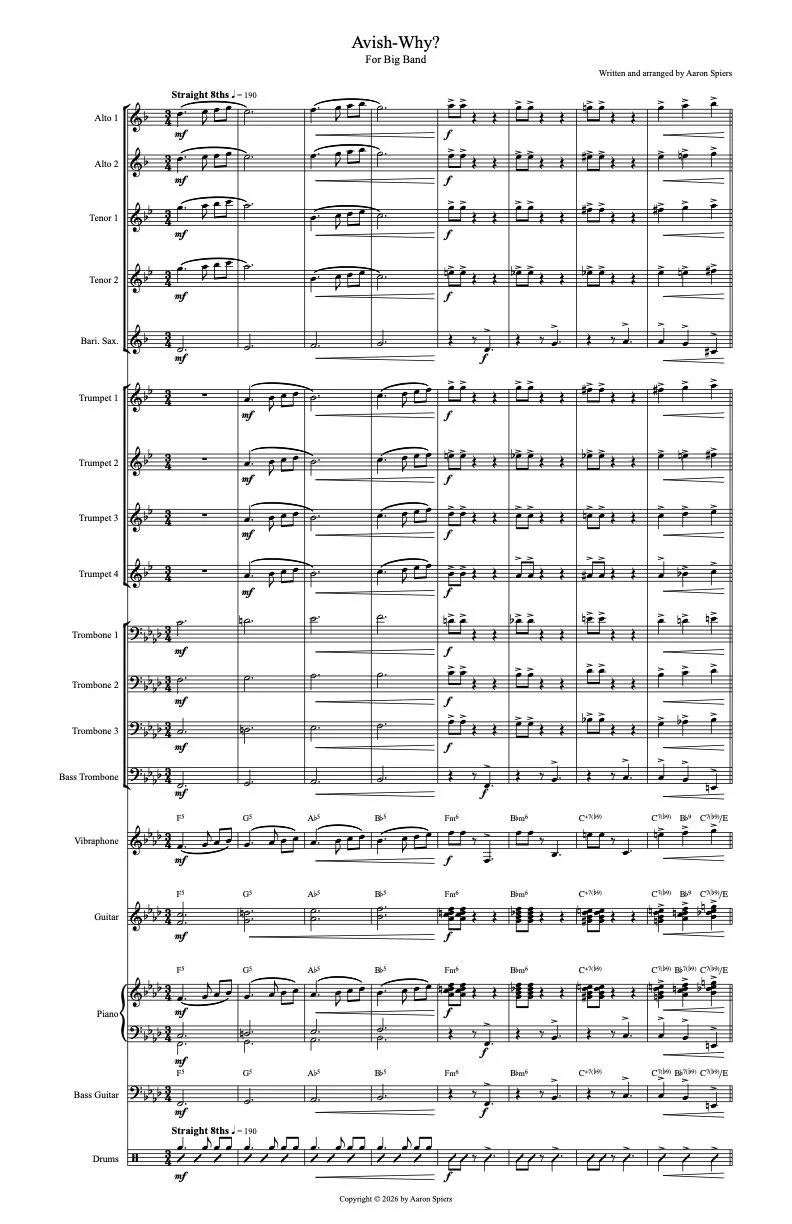 Image 2 of 2
Inspired by the rhythmic vitality and melodic approach of acclaimed bassist and composer Avishai Cohen, Avish-why? is a contemporary jazz orchestra work that combines an infectious bass-driven groove with economical harmonic language and evolving orchestration. Rather than relying on harmonic complexity, the composition develops through rhythmic momentum, motivic development, and continual changes in ensemble colour.
The work is built around a predominantly 3/4 pulse, with strategically placed 4/4 measures that propel the music naturally into new sections of the form. This subtle manipulation of meter creates forward motion while remaining intuitive for both performers and listeners.
The formal structure follows Intro, Head, Piano/Rhodes Solo, Trombone Solo, Saxophone Soli, Shout Chorus, Head Out, and Outro, allowing each section of the ensemble to contribute to the narrative while maintaining a clear and accessible framework.
Throughout the score, the orchestration moves fluidly between two-part textures, small ensemble combinations, and full jazz orchestra writing. The saxophone soli serves as a bridge between the improvisational sections and the climactic shout chorus, while the rhythm section provides the constant foundation that drives the piece from beginning to end.
Although rooted in a simple harmonic framework, the composition demonstrates how orchestration, rhythm, and texture can generate musical interest without excessive harmonic density. The study score highlights approaches to contemporary groove writing, mixed-meter transitions, motivic development, and economical orchestration for jazz orchestra.
As with much of Aaron Spiers' writing, Avish-why? places equal emphasis on ensemble interaction and rhythmic precision, illustrating how a modern jazz orchestra can achieve energy and momentum through clarity of concept rather than complexity alone.
Inspired by the rhythmic vitality and melodic approach of acclaimed bassist and composer Avishai Cohen, Avish-why? is a contemporary jazz orchestra work that combines an infectious bass-driven groove with economical harmonic language and evolving orchestration. Rather than relying on harmonic complexity, the composition develops through rhythmic momentum, motivic development, and continual changes in ensemble colour.
The work is built around a predominantly 3/4 pulse, with strategically placed 4/4 measures that propel the music naturally into new sections of the form. This subtle manipulation of meter creates forward motion while remaining intuitive for both performers and listeners.
The formal structure follows Intro, Head, Piano/Rhodes Solo, Trombone Solo, Saxophone Soli, Shout Chorus, Head Out, and Outro, allowing each section of the ensemble to contribute to the narrative while maintaining a clear and accessible framework.
Throughout the score, the orchestration moves fluidly between two-part textures, small ensemble combinations, and full jazz orchestra writing. The saxophone soli serves as a bridge between the improvisational sections and the climactic shout chorus, while the rhythm section provides the constant foundation that drives the piece from beginning to end.
Although rooted in a simple harmonic framework, the composition demonstrates how orchestration, rhythm, and texture can generate musical interest without excessive harmonic density. The study score highlights approaches to contemporary groove writing, mixed-meter transitions, motivic development, and economical orchestration for jazz orchestra.
As with much of Aaron Spiers' writing, Avish-why? places equal emphasis on ensemble interaction and rhythmic precision, illustrating how a modern jazz orchestra can achieve energy and momentum through clarity of concept rather than complexity alone.